
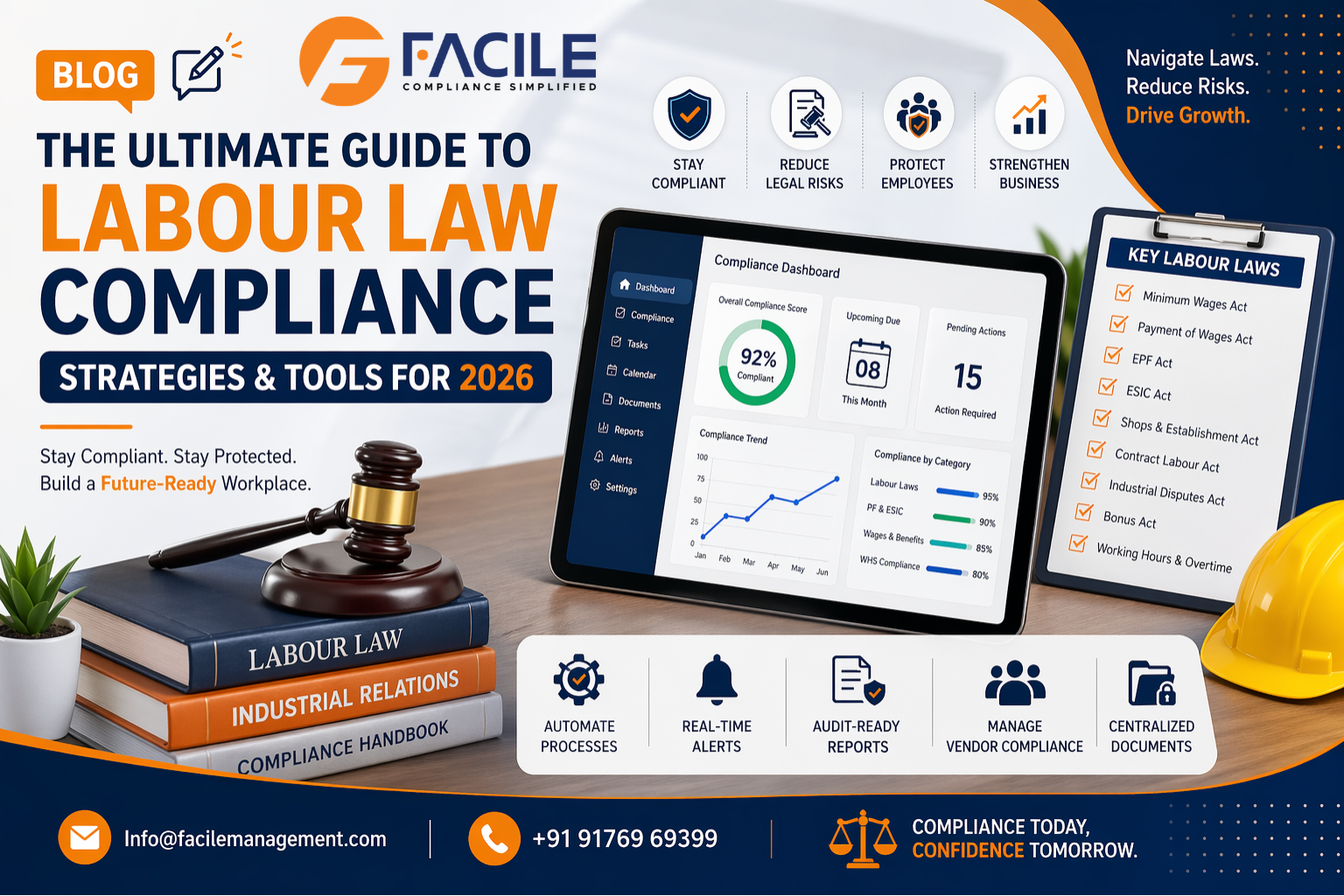
Labour law compliance has become one of the most critical responsibilities for businesses in 2026. With increasing regulatory scrutiny, evolving workforce structures, and stricter enforcement by authorities, organizations can no longer afford to treat compliance as a secondary function.
From employee wages and benefits to workplace safety and vendor accountability, labour laws govern every aspect of workforce management. Non-compliance can lead to heavy penalties, legal disputes, and reputational damage.
To navigate this complexity, businesses are adopting structured and technology-driven approaches, such as those offered by Facile Management Services, to streamline labour law compliance and stay ahead of regulatory challenges.
Labour law compliance refers to the process of adhering to all legal requirements related to employment and workforce management. These laws are designed to protect employees’ rights and ensure fair treatment in the workplace.
India’s labour law framework includes numerous central and state laws, making compliance challenging for businesses operating across multiple locations.
Government authorities are implementing stricter checks, inspections, and penalties for non-compliance.
The rise of gig workers, contract labor, and remote employees has added new dimensions to compliance requirements.
Regulatory bodies are moving toward digital compliance systems, requiring businesses to adapt quickly.
Ensures employees receive fair wages as per government standards.
Regulates timely payment of employee salaries.
Mandates contributions toward employee retirement benefits.
Provides medical and social security benefits.
Governs working conditions in commercial establishments.
Regulates employment of contract workers.
Different states have different rules, formats, and filing requirements.
Reliance on spreadsheets and manual tracking leads to:
Organizations are responsible for ensuring their vendors comply with labour laws.
Keeping up with changing regulations is difficult without dedicated systems.
Use a unified system to manage all compliance activities.
Automate:
Identify gaps and fix them proactively.
Ensure awareness of compliance requirements across teams.
Track and verify vendor submissions regularly.
Modern compliance tools are transforming how businesses manage labour laws.
Technology is redefining compliance management through:
Reduces manual effort and errors.
Provides instant visibility into compliance status.
Helps identify trends and risks.
Enables scalability and remote access.
Avoid penalties and legal issues.
Ensure fair wages and benefits.
Streamline processes and reduce workload.
Build trust with stakeholders.
As highlighted on
👉 https://www.facilemanagement.com/labour-law-compliance-services
Facile Management Services provides comprehensive labour law compliance solutions, including:
From registration to reporting.
Handle complex regulations across locations.
Generate statutory records instantly.
Ensure third-party compliance.
Maintain records for inspections and audits.
Monitor legal changes regularly.
Use automation for efficiency.
Keep records accurate and accessible.
Identify and resolve compliance gaps.
Predict and prevent compliance issues.
Connect HR, payroll, and compliance platforms.
Instant insights into compliance performance.
Labour law compliance is no longer optional—it is essential for business success.
By adopting modern tools and strategies, businesses can:
The future belongs to organizations that prioritize compliance and embrace automation.
It is the process of adhering to laws governing employee rights and workplace conditions.
It ensures legal protection, employee welfare, and business continuity.
Minimum Wages Act, EPF, ESIC, Shops & Establishment Act, and Contract Labour Act.
By using automated compliance systems and following best practices.
Ensuring third-party vendors follow labour laws.
It reduces errors, saves time, and improves efficiency.
It may face penalties, legal action, and reputational damage.
Yes, with the help of digital tools and services.
Being prepared with proper documentation for inspections.
Continuously using real-time systems.
Records required by law to maintain employee and wage details.
Yes, state laws vary significantly.
It automates processes and provides real-time insights.
By centralizing compliance and using automation tools.
You can explore services from Facile Management Services.


Facile Management Services (OPC) Private Limited is committed to delivering seamlessly integrated HR and compliance solutions designed for the evolving