
A Complete Guide to Managing Vendor Compliance, Reducing Risk, and Strengthening Business Operations
In today’s complex business ecosystem, organizations rely heavily on third-party vendors for services such as staffing, logistics, manufacturing, and facility management. While outsourcing improves efficiency and scalability, it also introduces significant compliance risks.
If a vendor fails to comply with statutory regulations—especially labour laws—the principal employer can be held legally responsible. This makes Vendor Audit Services a critical function for businesses aiming to maintain compliance, avoid penalties, and protect their reputation.
Modern organizations are increasingly partnering with experts like Facile Management Services to ensure systematic and reliable vendor compliance management.
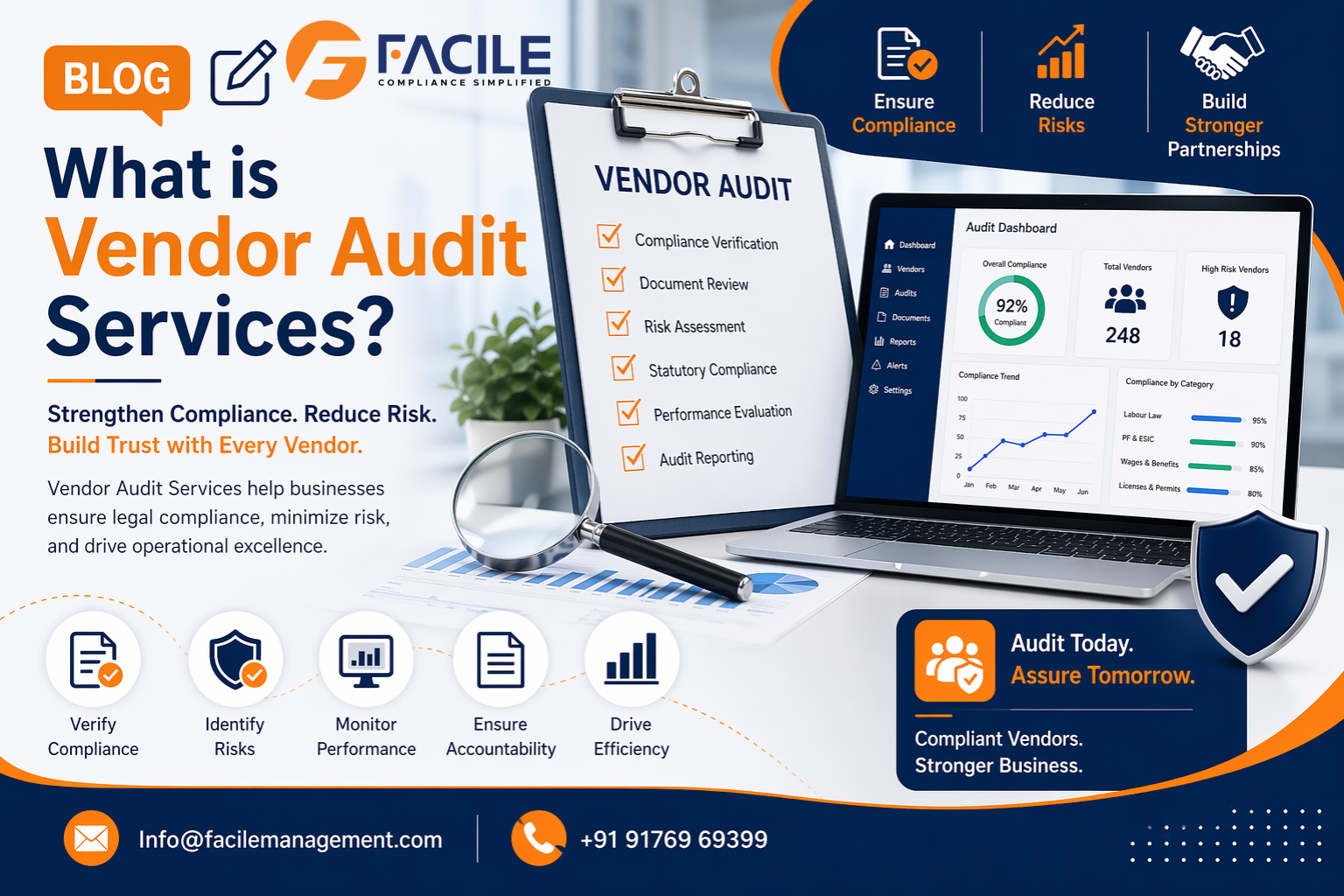
Vendor Audit Services refer to the process of evaluating, monitoring, and verifying whether third-party vendors comply with applicable laws, regulations, and contractual obligations.
It is a structured approach to ensure that your vendors:
Businesses are legally responsible for their vendors’ compliance, especially under labour laws.
Non-compliant vendors can lead to:
Ensures adherence to:
Maintains trust with stakeholders, clients, and authorities.
Checks adherence to statutory and legal requirements.
Verifies financial records and transactions.
Evaluates efficiency and performance of vendor operations.
Ensures proper maintenance of statutory records.
Focuses on high-risk vendors and areas.
List all vendors and categorize them based on risk level.
Gather:
Analyze compliance status against legal requirements.
Identify:
Prepare detailed audit reports with findings.
Ensure vendors take necessary corrective measures.
Managing multiple vendors across locations is complex.
Manual processes lead to:
No centralized system to monitor vendor compliance.
Vendors may not maintain proper records.
Modern compliance platforms offer:
Track all vendor compliance activities in one place.
Automate document collection and verification.
Get instant updates on compliance status.
Receive reminders for pending submissions.
Identify and address issues early.
Ensure vendors meet compliance standards.
Use data insights to evaluate vendors.
Avoid penalties and reduce operational costs.
Maintain proper documentation for inspections.
| Aspect | Vendor Management | Vendor Audit |
|---|---|---|
| Focus | Performance & operations | Compliance & risk |
| Objective | Improve efficiency | Ensure legal adherence |
| Frequency | Continuous | Periodic |
| Outcome | Better vendor relationships | Reduced compliance risk |
Focus more on high-risk vendors.
Use digital systems for document storage.
Reduce manual effort.
Ensure continuous compliance.
Set expectations and compliance requirements.
As referenced from
👉 https://www.facilemanagement.com/vendor-audit
Facile Management Services provides comprehensive Vendor Audit Services, including:
From onboarding to audit reporting.
Monitor compliance status in real-time.
Highlight high-risk vendors and issues.
Ensure accurate and complete documentation.
Prepare businesses for inspections and audits.
The future is driven by:
Predict compliance risks before they occur.
Reduce manual intervention.
Connect vendor management with compliance tools.
Instant insights into vendor performance.
Vendor Audit Services are no longer optional—they are essential for businesses that rely on third-party vendors.
By implementing structured vendor audits, organizations can:
A proactive approach to vendor auditing leads to a safer, more efficient, and compliant business environment.
They are services that evaluate vendor compliance with legal and contractual requirements.
They help reduce risks, ensure compliance, and protect businesses from penalties.
Ensuring vendors follow applicable laws and regulations.
Regularly, depending on risk level and business requirements.
Licenses, statutory registers, PF/ESIC records, and contracts.
Yes, businesses can be held legally responsible.
It improves accuracy, saves time, and provides real-time tracking.
All industries that rely on third-party vendors.
Focusing audits on high-risk vendors.
By identifying issues early and ensuring smooth operations.
No, vendor audit focuses on compliance, while vendor management focuses on performance.
Areas where vendors fail to meet legal requirements.
By using automated systems and conducting regular audits.
Being prepared with proper documentation for inspections.
You can explore services from Facile Management Services.


Facile Management Services (OPC) Private Limited is committed to delivering seamlessly integrated HR and compliance solutions designed for the evolving
No Related Post